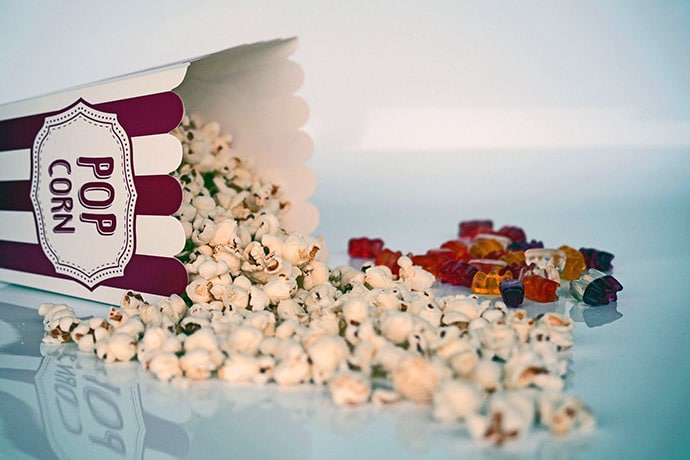
Snack content: definition
What actually is snack content? Snacks are small pieces of content that can be consumed quickly – like snacks, they are small, tasty bites that don’t hold you up for long. They are visually appealing and attract attention. Snack content includes content such as GIFs, memes, short videos, info cards, quote posts and cinemagraphs.
Snack content can bring your social media channels enormous benefits: people usually interact with video and audio snacks many times more than with other social media posts.
Our tip:
Snack content is comparatively quick to produce, works well in series and is therefore relatively inexpensive. You can read how prices for film services are made up here.
This greatly increases the profitability of snack content compared with other video marketing tools. Find out more about the return on investment of video marketing here.
Because snack content is only about 3–8 seconds long, it fits perfectly with how target groups consume content on social media today: according to a study by Microsoft, the human attention span is now only around eight seconds. With snack content, you not only capture this span but also convey all the important information.
Snack content is also perfect for mobile browsing, because unlike longer videos it saves data volume. People browsing on mobile are therefore at no disadvantage and can enjoy snack content fully.
Because snack content is only about 3–8 seconds long, it fits perfectly with how target groups consume content on social media today.
Types of snack content
There are different types of snack content, each suited to different companies, products and purposes. All types can carry different content. An overview of the types:
GIFs
GIFs (Graphics Interchange Format) were originally image formats for use on the internet with lossless compression. Today, however, the term usually refers to “animated GIFs”, i.e. a sequence of 2 or more images within one image. The advantage of GIFs is that they repeat continuously and so run in an endless loop.
GIFs can be used on almost any text/image social media platform such as Facebook, Instagram and Twitter, but also in a blog article or on your website.
Viewers expect GIFs to entertain, so feel free to be humorous here. In addition, GIFs don’t need sound. Statements are often shown as subtitles instead.
GIFs can be used on almost any text/image social media platform such as Facebook, Instagram and Twitter, but also in a blog article or on your website.
Vines
Vines are short videos of up to 10 seconds that loop (repeat) automatically because they are so short. They owe their name to the video platform of the same name (since discontinued) that made this video format famous.
These short videos fall within a user’s attention span of around 8 seconds and therefore achieve greater reach and more views of the content. A sub-form of vines can also be several GIFs strung together, but vines tend to refer to continuous videos (24+ frames per second).
In terms of content, they can be unboxings, sneak peeks of something new or the intro of a longer film (e.g. your corporate film). They work best on Instagram, because Instagram automatically loops videos under 8 seconds long, but also on Facebook, Twitter or a website.
Vines can be humorous as well as serious, impressive or emotional. As part of a video marketing campaign, they are very inexpensive to produce and ideally can even be a by-product of other film types. You can find an overview of different film types here.
Cinemagraphs
Cinemagraphs (a new English word combining “cinema” and “photograph”) are photos with moving elements. What makes cinemagraphs stand out from the crowd is the unexpected movement in the image. The point is not to make a person move, but to make the background move. Suitable moving elements include hair (blowing in the wind), water (e.g. waves, waterfalls, fountains, rain), fabrics (moving in the wind, flowing) or light and smoke (fireworks, steam, smoke, sparklers).
Cinemagraphs take a little more effort to create, but are still very inexpensive to produce compared with other video marketing elements.
Cinemagraphs work best of all on Instagram, where they stand out most from the uniform mass of (still) images. On other social media platforms they are shown as videos that first have to be started and don’t always run in an endless loop.
Cinemagraphs primarily serve to catch the user’s eye and force conscious attention. This way they generate more attention.
Cinemagraphs take a little more effort to create, but are still very inexpensive to produce compared with other video marketing elements.
Memes
Memes aren’t a genre of their own but more an internet phenomenon of pop culture. A striking image is combined with a short text (often taken out of context). The image is usually static, but can also be a GIF or vine. The text is often in large bold letters.
Over time, certain images and statements have become established and are combined again and again with the aim of entertaining the user, criticising the system or establishing the sender as part of the community.
Companies can also establish their own memes. The key is the constant repetition of certain images and/or statements – regardless of context. For example, you can put your slogan (let’s say it’s “Thinking in squares”) on all sorts of images that allow even the slightest association with it, however tenuous: a cat on a tiled floor. A goldfish in a round bowl. A child’s drawing of a house. The more amusing the result, the more successful the meme.
Particularly successful memes are shared by the community or even redesigned. Encourage your fans and followers to submit their own memes on “Thinking in squares” (or whatever your slogan is).
Memes become established through constant repetition and the combination of images and texts that seem completely different at first glance. This anchors them in the target group’s subconscious, and they stay with people even when they aren’t looking at your social media content.
Ideally, a customer of yours will at some point see a structure somewhere – perhaps in a children’s playground – and your slogan will come to mind. The crowning glory of your social media success is when the customer immediately pulls out their phone and creates a new meme for you.
Memes are found on all social media platforms, but above all on Facebook, Pinterest and in forums.
Quote posts
Quote posts are also combinations of text and image (or video). However, they don’t aim solely at entertainment through absurdity, but mainly at philosophy, knowledge and information. Quote posts can be funny (sarcastic quote collections are an example), but are often used in connection with motivation, success and self-improvement, where they are very popular.
The big advantage of quote posts is that users like to share them with their friends, i.e. tag friends or share the post directly. As the sender (of course you should discreetly mark all your quote posts with a reference to your brand and/or your social media channels), you get greater reach and also reach users who weren’t previously in your social media bubble.
Quote posts work particularly well on Pinterest, Twitter and Facebook, but also with a somewhat smaller group of users on Instagram.
The big advantage of quote posts is that users like to share them with their friends, i.e. tag friends or share the post directly.
Benefits of snack content
What can you do with snack content? First and foremost, snack content is a great change from your classic posts. You are, in effect, opening a finger-food buffet: everyone who passes by happily helps themselves and, while enjoying it, cheerfully carries the hors d’oeuvre to their friends.
With snack content you can:
- Get content across at a glance
- Offer brief entertainment
- Show variety
- Announce promotions
- Easily draw users to your profile (or your landing page/web shop)
- Get your fans and followers to interact
- Generate a lot of reach with little effort
- Liven up your social media activities
That’s why snack content should be part of every editorial plan. Read how an editorial plan can help your social media marketing here.
Creating snack content (or having it created)
Snack content is cool and should definitely feature in your social media marketing. When creating it, you can give free rein to your creativity and experiment. However, the same caution applies here as everywhere in social media marketing: precisely because everything seems so familiar and “easy”, we should let professionals do the job, at least at the beginning. Still waters run deep, as they say.
Our tip:
Creating the right content can be difficult, so consider bringing a professional social media agency on board.
The type and content of the most suitable snack content for your social media channels naturally also depend on your overall social media strategy: what makes your target group tick, what drives it? It makes little sense to show business people nothing but cat content, or beauty queens nothing but motivational quote posts. Our tip: tailor your snack content to your social media channels – or bring a specialised partner on board for this.
Checklist: does social media make sense for me?
The following questions can help you decide:
* Is my product used by consumers/private users? Or does it at least belong to a topic that interests private users?
* Is my target group media-savvy?
* Do I have a clearly defined target group that I can’t reach well through other channels?
* Do I want to learn more about my target group? * Do I want to build a brand and give it positive associations? * Do I have a blog?
If you now have an idea or two of what snack content is and how you can use it profitably for your social media marketing, then this article has already been worth it. Subscribe to our newsletter (in German) to receive future blog articles directly in your inbox.
We would be delighted if you find more inspiration on this blog, recommend us or subscribe to our newsletter.
You can also visit us on our social media channels:
@PStudios on Twitter
@pathfinder.studios on Facebook
@pathfinderstudios on Instagram
See you soon!

