
Your company has a brand video, but you want or need to change it? Find out whether and when changes to existing brand videos are possible, what to bear in mind and what costs you may face.
Contents
Why should I change my brand video?
There are many reasons why companies want to change an existing brand video: your brand video is getting a bit dated, some topics have since been dropped from your services, or new technologies have replaced old methods? Perhaps you also want to show your brand video at a trade fair, but it is too long or not quite right?
In these cases, it can make sense to change an existing brand video:
- Staff changes (employees shown have left the company)
- Changes to your portfolio (new, discontinued or changed services)
- New uses (e.g. social media, trade fairs, cinema etc.)
Can I update my brand video?
In the world of film, almost anything is possible – the so-called magic of film. So don’t worry: an old brand video isn’t necessarily lost. It can be shortened, changed and adapted. Extending it with new scenes is also an option, for example to include a new department or the new managing director. All these measures save you costs and can breathe new life into your old brand video.
Updating your brand video lets you:
- Adapt it to current company structures
- Update it with the latest facts & figures
- Give the film a more modern look
- Create new ways to use it (trade fairs, advertising etc.)
- Update it to your company’s new corporate design
Do you have the raw files of your brand video?
You will be asked this question when you approach a new film production company or freelancer. Raw files are a decisive cost factor when editing. You are probably wondering why. A finished film can be thought of like a finished CD: all the components (music, voice-over, footage etc.) are pressed together into one big whole that can no longer be separated without the raw files.
For example, changing the voice-over also requires adjusting the music, because the two are “welded together”.
You can request the raw files from the film production company or agency that produced your brand video and then buy them.
A word of warning up front: not every film production company is happy to hand over its raw files if you want to work with another partner. So there may be extra costs, both for opening the archive / handing over the files and for usage and editing rights for third parties.

- Raw files are not a must
- Raw files make the work easier and save time and costs when making changes
- Raw files are bought from whoever made the film
How can I change my brand video?
Changes can basically be split into two areas – content and appearance. Appearance covers everything to do with design and style, while content covers changes to text overlays or the voice-over script.
Content changes include, for example:
- Changing the text of overlays
- Changing the voice-over script
- Recording the voice-over in another language
Changes in style or design include, for example:
- Style of overlays (animation, colours, design)
- Colour style of the film
- Changes to the edit (shorter, more modern or cutting out certain people)
- Replacing an old logo
- New music

Can I retouch old logos?
I already mentioned the magic of film, remember? That also applies to logos burned into your film – whether on clothing, machines, cars or company buildings.
The logos can be removed completely and replaced with your new, modern logo.
This also applies to moving objects and people: the logos are inserted into the footage, adjusted for perspective and then tracked and animated. As if there had never been another logo in the film – magic, isn’t it?
Example of logo retouching:
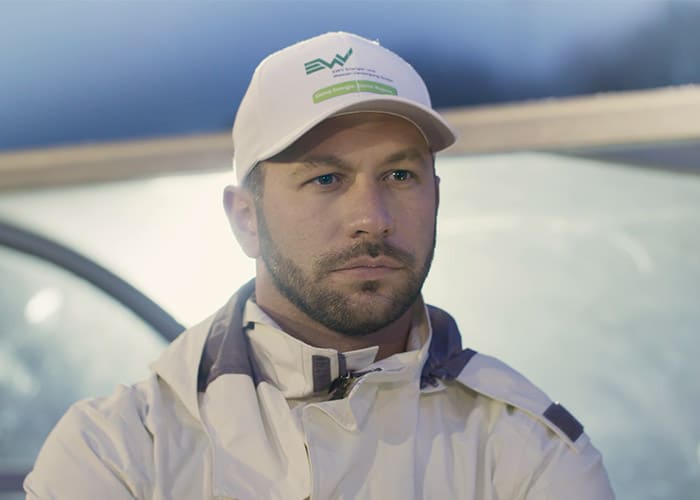

- old logos can be removed
- new logos can be inserted
- they can be replaced on both static and moving objects
Can I change the overlays in my brand video?
If you no longer like the old overlays or texts such as headcount figures need updating, changing the overlays is the solution.
The style of overlays can make a film look younger, more modern and above all more professional, and it catches the eye.
Examples of overlays:


To edit overlays where there are existing ones, you need the raw files to remove the old ones and replace them.
If you would like overlays and there aren’t any yet, they can also be added without raw files.
- To change existing overlays, you need raw files
- If the film doesn’t have overlays yet, they can easily be added
- Overlays can make a film more modern
Can I cut out former employees?
Technically: yes. In terms of storytelling and editing: yes and no. It all depends on what role the employee plays in your brand video and whether the film still works once the employee has been cut out. If it is an employee who walks through the frame once, that is of course unproblematic and not necessarily relevant to the story of your brand video. But if the employee has a large part or even the leading role in your brand video, things are naturally more difficult. A reshoot may then be needed to replace the missing sequences.
Can I shorten my brand video for a trade fair or advertising?
Shortening a brand video for a trade fair is a very popular change and can create a new way to use it with little effort. To actually take the brand video to the trade fair, however, you need additional exploitation rights to use the film there.
Most brand videos come with usage rights for online and social media, but then have to be relicensed for trade fairs or advertising.
The new licence can have a few pitfalls, because besides the film itself, the voice-over artist, the music and the actors have to be asked again and the licence bought.
Another point, just as with “cutting out employees”, is that shortening the film may break its story so that a short version no longer works. That is a risk, but one worth taking, because testing whether it could work is a lot cheaper than a new shoot for an advert or a trade fair film.
- The brand video can be shortened for a trade fair or advertising
- To be allowed to show the brand video at a trade fair, you need the usage rights of everyone involved (voice-over artist, music etc.)
- You have to keep the story in mind so that the film still works in a shortened version
How much do changes to a brand video cost?
Changes to your brand video can range from two figures to four or even five figures – depending on effort, complexity and the length of the film. All creatives bill changes at hourly or day rates. Providing the raw files is therefore a big cost lever, because they save the creative a lot of time and so save you costs.
Example: if you want to replace a logo in a 5-minute brand video in which the logo appears 20 times, this is more expensive than in a 2-minute brand video in which the logo appears only 5 times.
Can I change my film from Full HD to 4K or UHD?
The basic requirement for increasing the resolution to 4K / UHD is that the footage was shot in 4K / UHD. There are ways to bring Full HD footage up to a pixel resolution of 4K / UHD afterwards through virtual upscaling, but it can never be as clean as original 4K and UHD footage. Simply ask the film production company that made your brand video whether a 4K or UHD version of the film is possible. Of course, this always involves costs, and it is much cheaper to decide on 4K resolution from the outset than later.
Where can I have my brand video changed?
If you want to have your brand video changed, your first port of call should always be the film production company, advertising agency or filmmaker who produced the original brand video. There are three reasons for this:
- The terms and conditions of whoever made it probably prohibit third parties from editing the brand video
- Ideally, they still have the open raw files
- The original maker already knows your company and your brand video
If you can’t or don’t want to approach the original maker, you have two options: a full-service film production company or a freelancer. The difference lies in professionalism and quality control – and, connected with that, the price.
A full-service film production company offers you the know-how needed for all changes and adjustments to your brand video to meet your standards. It takes care of everything from A to Z and brings in exactly the right people to rework your project.
The cheaper approach is freelancers, such as voice-over agencies or sound designers. However, I only recommend this route if you know exactly what you want and where to get it.
Can I change my brand video myself?
Unfortunately, the answer in most cases is no. Changes to brand videos require technical and content know-how and the right equipment. And in most cases you don’t have the rights to make changes.
Background: under German copyright law, a brand video is an artistic work and in most cases may only be changed by its author. It’s best to ask whoever made your brand video what options you have.
But even if you have the technical requirements and the necessary rights, I always recommend bringing in a professional.
Conclusion: changing your brand video
There are many ways to change your brand video, make it more modern or give it a new voice-over. Costs vary depending on the effort the changes involve.
Some changes to a brand video can be retouched out or added comparatively easily; some need the raw footage and the associated rights; and sometimes only a reshoot or new animation will help. But it is usually worth it and can improve your brand video or bring it up to date. It’s best to ask the film production company you commissioned – or a new film production company you trust – for a no-obligation conversation about your plans.
Simply click here for a no-obligation conversation with us.
If you would like to look more deeply into changing a brand video and the related costs and information, I recommend the following articles:
- The brand video – everything companies need to know
- Brand video costs – how much does a good brand video cost?
- Where should I show my brand video? How to reach the most customers
- Brand videos in English – how does it work and is it worth it?
- Brand video costs per minute – the biggest misconceptions when calculating