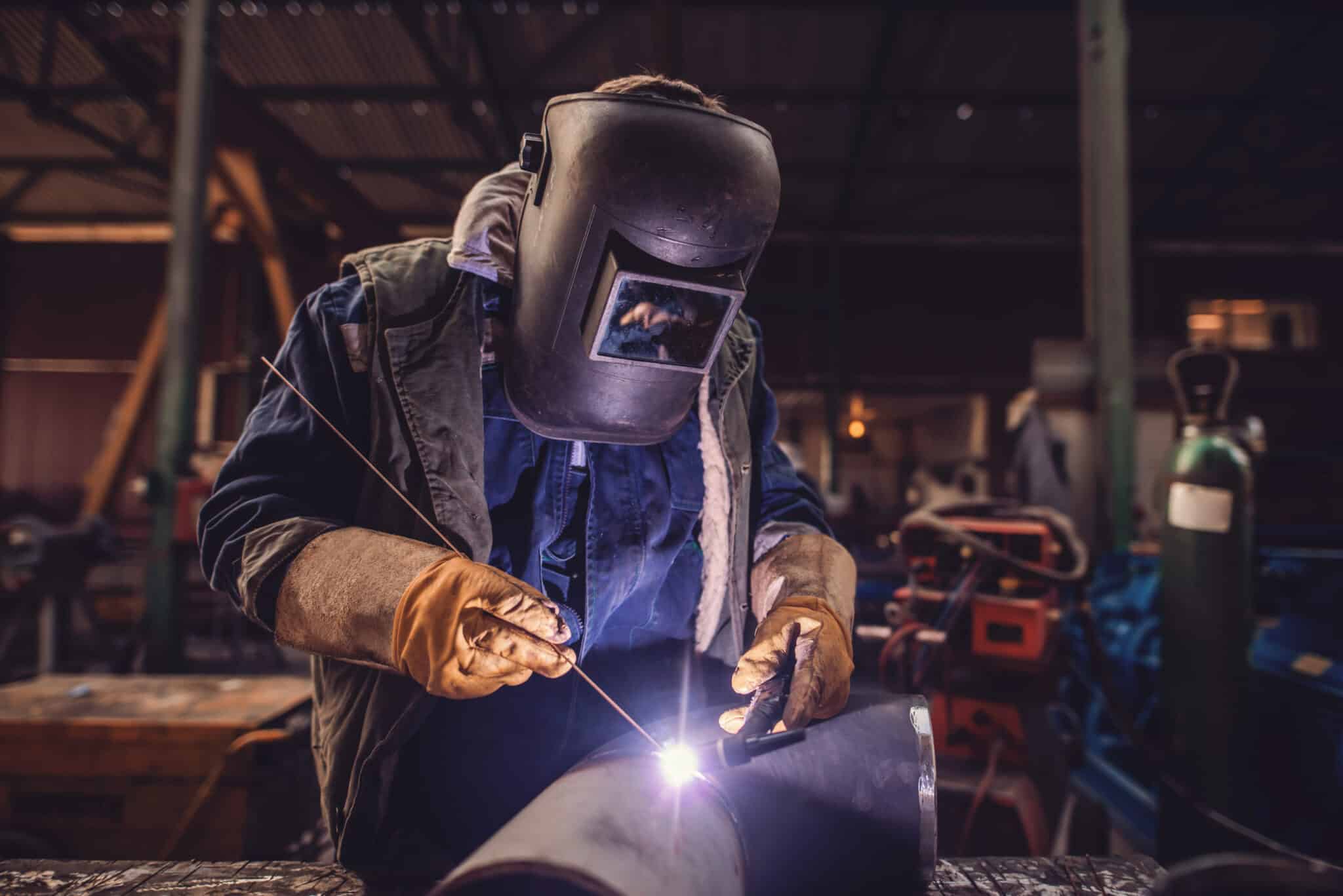
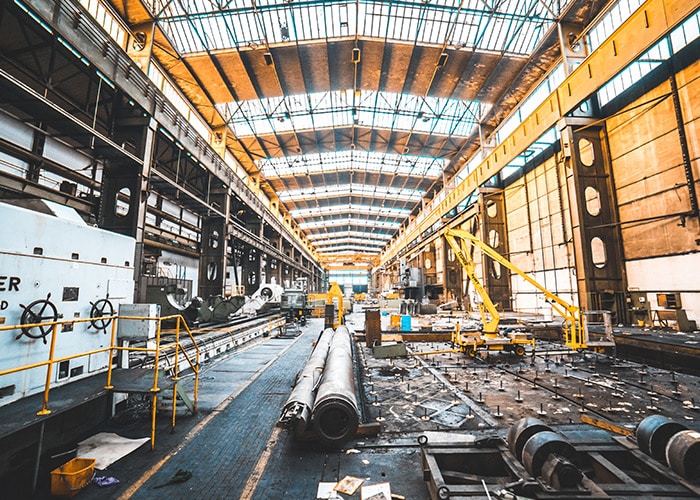
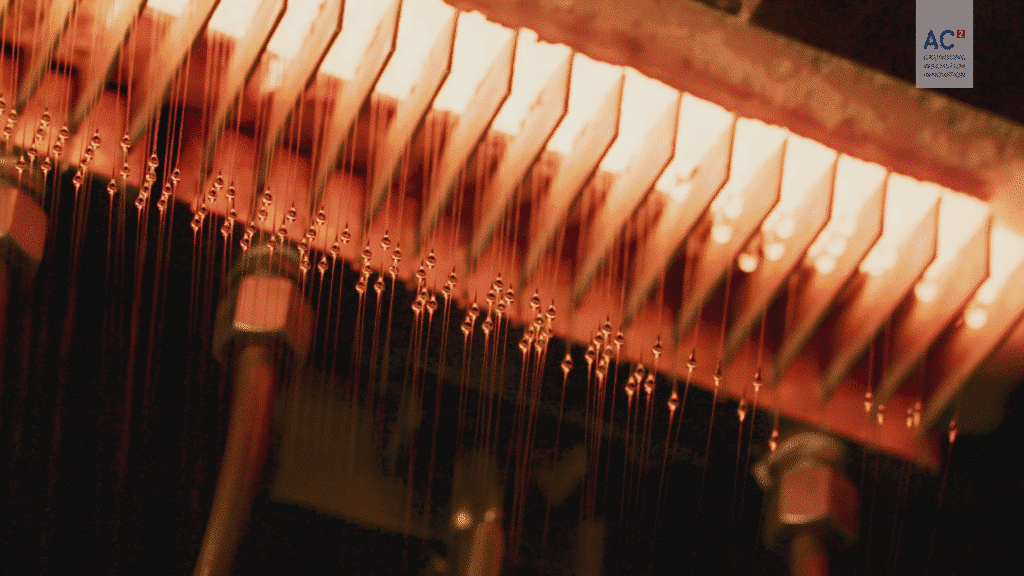
Worker welding iron. Protective suit and mask on. Workshop interior.
An industrial film is a flagship for Germany’s mid-sized companies. It allows manufacturers to explain complex processes and communicate product benefits, inspire new applicants and win over international partners.
Read everything companies need to know about the industrial film, watch examples and compare prices and ROI (return on investment).
Produced with a clear goal, the industrial film can be used in many different ways. Read on to find out exactly what an industrial film is and how it can be used.
What is an industrial film?
An industrial film is a sub-type of the company film that describes operational processes, content and workflows. Unlike the corporate film, the industrial film focuses not on emotions and personality but on facts and processes. Industrial films are therefore particularly useful for internal communication – for example to train employees, inform stakeholders (groups/people who can influence the company) or explain and implement departmental goals.
Industrial films are often produced for both internal and external goals. An industrial film can explain internal processes and so replace, for example, a long written production manual. This saves time, is more enjoyable and helps employees remember things better. Another use is induction to certain areas, because every employee or visitor to an industrial site has to be briefed. Why not explain it all in a film instead of constantly pulling the responsible colleague away from their work?
unlike the corporate film, an industrial film is rational and fact-focused rather than emotional
describes processes, content and workflows
mainly for internal communication: employee training, stakeholder information, departmental goals
saves costs and resources
raises the profile of departments and serves as a best-practice example
Industrial film vs. corporate film
Clients often ask what exactly the difference between a corporate film and an industrial film is. The industrial film conveys information on a factual level, often for a specialist B2B audience.
The corporate film, by contrast, sets out to build an image – conveying emotions, values and messages – and addresses a broad audience. Factual information takes a back seat.
A corporate film therefore builds an emotional relationship between viewer and company, mainly through people and interaction. Not quite as strongly as in advertising, but in the same direction. If you watch German TV now and then, you will surely recognise – even if only subconsciously – the face of electronics retailer Saturn’s “Tech-Nick” or of “Dr. Hipp” from the baby food adverts. Exactly the same thing happens with a corporate film.
A corporate film communicates on an emotional level
A corporate film shows people, competences and emotional values
The industrial film communicates on a factual level
An industrial film shows the company’s processes, content and workflows
What can an industrial film be used for?
Industrial films are mainly used internally, i.e. for your own employees and stakeholders (groups/people who can influence the company). This is also because industrial films often show specific production processes and sensitive trade secrets. Depending on content and focus, however, an industrial film – or parts of it – can also be used for external communication.
Showing and explaining processes
An industrial film mainly explains production processes. This can be done in two different ways. On the one hand, such a film can be used as a teaching and training film for apprentices and new employees (after hiring) to explain internal processes. It gives viewers an insight into the “how” and saves you time and work in training your employees. On the other hand, such a film can be used to present your product clearly to the customer and explain its process and function. (Here, however, we are usually talking about explainer videos.)
Training employees and bringing them on board
In manufacturing companies, the individual departments are often strongly separated, so administration (e.g. sales, purchasing and marketing) rarely knows exactly how production works, and vice versa. It quickly happens that one side doesn’t know what the other is doing. Yet, especially for selling the products, it is crucial to know how they are made and how complex processes within the company work. Industrial films are therefore ideal for training employees regularly and bringing all departments up to the same level. Whenever an innovation is coming up, an industrial film pays off enormously.
Informing stakeholders
Industrial films are also often used to inform stakeholders about processes and process innovations. Since this is almost always a specialist audience, the industrial film can go into technology, connections and facts more than, for example, a corporate film aimed at the general public.
Stakeholder communication includes reporting “upwards”, for example when national or international management or important partners visit. But it also includes communication “downwards and outwards”, for example to make suppliers aware of your own processes, quality standards and workflows. An industrial film always helps to illustrate internal quality assurance and good process management.
Secondary uses: PR, HR and marketing
An industrial film is usually very technical and fact-based. It is aimed at a specialist audience and is therefore only partly suitable for external communication with customers, applicants or the public. Nevertheless, an industrial film – or parts of it – can also be used for public relations (PR), for recruiting, HR marketing and employer branding (HR) or for classic marketing.
However, all of the following examples should only be considered as secondary uses, so that the actual purpose of the industrial film isn’t lost. If external communication matters more to you, a corporate film may be the right choice.
Public relations (PR)
Recruiting, HR marketing and employer branding (HR)
classic marketing
trade fair appearances
social media and website
Trade fairs and events
A trade fair film draws customers to the stand or visualises individual processes on the stand. Depending on how it is made, an industrial film or parts of it can be used for this. However, it does not replace a full trade fair film produced specifically for this purpose that fully achieves this goal.
Recruiting apprentices
Recruitment videos show potential employees and applicants the everyday workflows and so make the job or the company attractive. Thanks to its technical character, an industrial film or parts of it can also be used for recruiting purposes. However, it will not make the company as attractive to apprentices and applicants as a dedicated recruitment video does.
Recruiting skilled workers
Like the apprentice film, the skilled-worker film belongs to the recruiting genre. However, the two films differ considerably in focus and tone. While apprentices are addressed in a modern way with an emphasis on training opportunities, qualified skilled workers are addressed more through company values and existing processes. Here, too, an industrial film can help in part.
Bringing your website to life
Websites are becoming ever more important. So if your industrial film doesn’t show processes and settings that are too confidential, you can also put it on your website to offer first insights. If your website matters more to you than your internal processes, we recommend a corporate film or web video instead.
Summary: what an industrial film can do
An industrial film is versatile
It can address different target groups: apprentices, skilled workers, new customers etc.
Used in a targeted way, it saves costs in sales
It improves your public image
Our free eBook on industrial films (in German)
The free “industrial film handbook” (in German) gives more detailed examples of the various ways an industrial film can be used, with marketing strategies and concept ideas.
How is an industrial film made?
Like any other company film, an industrial film consists of pre-production, the shoot and post-production. Depending on the focus, more or less time is spent filming on site at your premises, and the film is complemented by more or fewer animations.
Pre-production
In pre-production, the film production company will hold a detailed briefing with you in which all the details are discussed. With industrial films in particular, this briefing very often goes hand in hand with a site tour, i.e. location scouting. This lets the production team get a direct impression of the size of the company and take it into account in the shooting schedule (set-up times, moves within the industrial halls, etc.). After the briefing, a script is written – the text that will later be recorded by a voice-over artist or delivered as interview soundbites from employees or customers, for example. As soon as the script is final and everyone is on board with the concept, filming can begin.
The shoot
The film crew brings everything the film needs: lighting, sound, cameras, tripods. Good film production companies have a dedicated team for industrial shoots that can act spontaneously and creatively and knows its way around industrial processes such as shift systems, break times and production workflows.
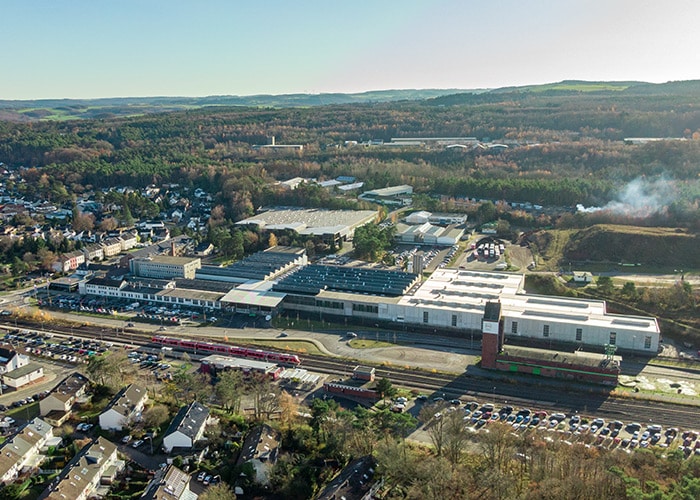
My recommendation: ask your film production company about aerial footage. Industrial companies are ideal for indoor and outdoor aerial shots. They convey the size of the company and are simply impressive!
Post-production
In post-production, everything comes together. The first step is the rough cut of the film, usually with a temporary voice-over that gives you a first impression of how the text might work with the images. At the rough-cut stage, you can pass on changes and wishes to the film production company, which are then implemented so the film can be finalised. Post-production is also where any necessary graphics, animations and visualisations are added – in 2D or 3D, stylised or realistic.
Your film project then receives colour grading, sound design and overlays such as logos and lower thirds. Et voilà!
The film consists of pre-production, shoot and post-production
The number of shooting days depends on the size of the company and the goal
Aerial footage can give an industrial film that certain something
Examples of what an industrial film could look like:
Aerial footage in industrial films
We can all agree on this: aerial footage is impressive. In an industrial film especially, aerial shots can enhance a film enormously and give your company the scale it really has. Aerial footage can reveal everything that ground-level shots can only capture to a certain degree.
Industrial companies often have large, heavy equipment whose operation can be interrupted by a light barrier. This means film cameras can’t always get close enough to capture everything. Aerial footage is a great alternative here too, so you don’t have to do without shots of the equipment. From above, the drone can often get closer and create new angles.
When and how should you produce an industrial film?
If you want to commission an industrial film, you have several options. If you already work with an advertising agency, it can be your first port of call – many advertising agencies have film partners. But be careful: the film production company must also suit you and your industry.
You can also search online for suitable film production companies yourself and request quotes. Ideally, the film production company has years of experience and can help you put together your individual film. It is always best to work with a team you get on with, because that makes it much easier to achieve your goals.
Who produces industrial films – film production company or advertising agency?
You can have your industrial film produced by three types of provider:
Film production companies
Agencies
Videographers
Film production company
The best partner for an industrial film is a film production company you trust. You can communicate directly with your contact person, without an intermediary in between. This works well for both sides: no misunderstandings, clear structures and a simple line of communication with direct feedback from the expert.
Besides creativity and know-how, the film production company brings the necessary skills in project management, rights management and consulting.
A film production company offers a full service from concept to complete production and marketing of the film, and is always your direct contact as an equal partner throughout.
Advertising agency
Most advertising agencies have added film to their portfolio. However, they usually don’t produce films themselves but work with film production companies.
Agencies are marketers, entrepreneurs and advertising professionals. They work with companies every day, know the target audience and can formulate marketing measures precisely and align them with previous ones.
Advertising agencies act as intermediaries between the company and the film production company and serve as the client’s voice throughout the project. In some cases, the agency writes the script and has the film production company make the film on that basis. It always keeps the target audience in view and has an overview of the production schedule.
Camera operators, copywriters, sound engineers or sound designers – these are all freelancers and a big part of every film production company. I can guarantee that almost every production involves at least one freelancer. They are creative, experienced and experts in their field.
As an alternative to a film production company or advertising agency, you can commission videographers and freelancers for your industrial film yourself. They are usually much cheaper and deliver a good end product. However, you need to keep three things in mind: professionalism, quality and service.
Videographers and freelancers are very creative and, as mentioned, experts in their field. But that is usually the crux: it is often a one-man show, meaning one person does everything. They are more easily overloaded, which can delay the delivery of your film.
Videographers and freelancers less often take care of the service mentioned above, which includes rights management, including filming permits or flight permits for aerial footage.
Note: Künstlersozialkasse (KSK) If you commission a freelancer or videographer in Germany, a certain percentage of the net fee must be paid to the Künstlersozialkasse, the German social insurance fund for artists. In 2019, the rate was 4.2%. Almost all creatives are affected: designers, copywriters, camera operators, directors, etc. The KSK levy is settled automatically at the end of the year, even if the creative is not a member of the Künstlersozialkasse. Corporations are exempt; their invoices are not subject to the levy.
FAQ: frequently asked questions about industrial films
What is an industrial film?
An industrial film is a business film for companies that presents the company comprehensively. It usually shows the actual production processes, manufacturing chains or products, often combined with the location, history and unique selling point or customer benefit.
Which companies need an industrial film?
Industrial films are particularly suitable for manufacturing companies in the B2B sector – ideal for company presentations, visitor groups or presentations to business partners worldwide. The industrial film is especially popular with mid-sized companies in industry, manufacturing, research, metals, pharmaceuticals and logistics.
What are the benefits of an industrial film?
An industrial film shows the size and competence of a company. It highlights product benefits and the company’s unique selling points. Real production facilities, machines and employees are often featured, and aerial footage is common too.
Who produces an industrial film?
Industrial films are produced by professional film production companies – specialist service providers of moving-image formats for businesses. In individual cases, advertising agencies are also involved, acting as intermediaries between the company and the film production company.
What is the difference between an industrial film and a corporate film?
An industrial film focuses on the company, its products and its market, and is factual and fact-oriented. A corporate film, on the other hand, aims to build an image and convey values. Industrial films are usually intended for a specialised B2B customer group with prior expertise, while corporate films are also suitable for the general public.
The three core strengths of an industrial film
Quality
Quality comes from creative, dynamic perspectives on industrial processes. High-quality lenses and 4K cameras, as well as 3D animations and graphics in line with your corporate design, ensure high quality on the technical side.
Presentation
Taking viewers to places they couldn’t go on a factory tour. Close-ups, slow motion and time-lapse can take the quality and know-how of your company to a new level in the film.
Information
Breathing life into tables and charts is the job of the industrial film: visualising facts and figures in a contemporary way through strong images and emotions.
Conclusion: the industrial film
Produced correctly and marketed well, an industrial film can be a powerful tool for internal communication – and, to a degree, for external communication. It can not only train employees, show processes and save costs, but ideally also win new customers.
You can find a particularly comprehensive overview of various best-practice examples of industrial films with use cases, cost estimates and statistics in our free industrial film handbook (in German).
Yvonne Schwalowski ist Marketingberaterin und strategische Filmproduzentin bei Pathfinder Studios sowie mehrfache Belletristik-Autorin u.a. beim Piper-Verlag. Mit 18 Jahren Berufserfahrung und erfolgreichen Multimedia-Projekten für 450+ Kunden ist sie eine erfahrene Marketing-Expertin für europäische Unternehmen – vom Tech-Startup über Hidden Champion-Industrieunternehmen bis zu Konzernen wie MAN, Miele und Audi. Ihre Werbefilme und Kurzfilme haben mehrere internationale Auszeichnungen gewonnen, ihr erster internationaler Kinospielfilm ist derzeit in Fertigstellung. Wikipedia – Portfolio – LinkedIn – IMDb
Yvonne Schwalowski ist Marketingberaterin und strategische Filmproduzentin bei Pathfinder Studios sowie mehrfache Belletristik-Autorin u.a. beim Piper-Verlag. Mit 18 Jahren Berufserfahrung und erfolgreichen Multimedia-Projekten für 450+ Kunden ist sie eine erfahrene Marketing-Expertin für europäische Unternehmen – vom Tech-Startup über Hidden Champion-Industrieunternehmen bis zu Konzernen wie MAN, Miele und Audi. Ihre Werbefilme und Kurzfilme haben mehrere internationale Auszeichnungen gewonnen, ihr erster internationaler Kinospielfilm ist derzeit in Fertigstellung.
Wikipedia – Portfolio – LinkedIn – IMDb