Instagram for Businesses – Why Instagram Is the Better Facebook
Facebook isn’t what it used to be – the rising star in the social media sky is Instagram. Read why Instagram is worthwhile for businesses and how you can increase sales and reputation through Instagram.
<em>Note: this article was first published in 2018 and last updated in 2020. The figures reflect that time.</em><br/>You can skip this section if you are a seasoned marketer or an experienced social media manager. Otherwise, here are the basics again:
The short version
Instagram is Facebook’s little brother and specialises in AV media (images and short videos). At the time of writing, the network had around 1 billion active users worldwide, 27 million of them in Germany.
Instagram launched in 2010 as a mobile social network for uploading private photos and short videos. From the very beginning, its various filters – preset colour and photo corrections that can give even a private snapshot that certain something – were especially popular.
In 2012, Instagram was bought by Facebook (now Meta) for 1 billion dollars and, by the time this article was written, had grown from 30 million to 800 million users worldwide.
The core content of Instagram is still photos and videos, which are shown to the users who follow your profile – much as Facebook users are “fans” of your Facebook page. Unlike Facebook, however, there are also #hashtags that users can follow. Through them, your images are also shown to users who don’t follow your profile yet, on a “you might also like” page. This means that users who match your target group may see the image too.
Another core component of Instagram is Instagram Stories: in a separate, prominently visible area, photos and videos are shown for 24 hours and then deleted automatically. This gives users a certain control over their own data and suggests a little more privacy in this transparent social media world. These short-lived photos and videos made its competitor Snapchat big at the time – and led to Snapchat’s sharp decline after Instagram copied the feature.
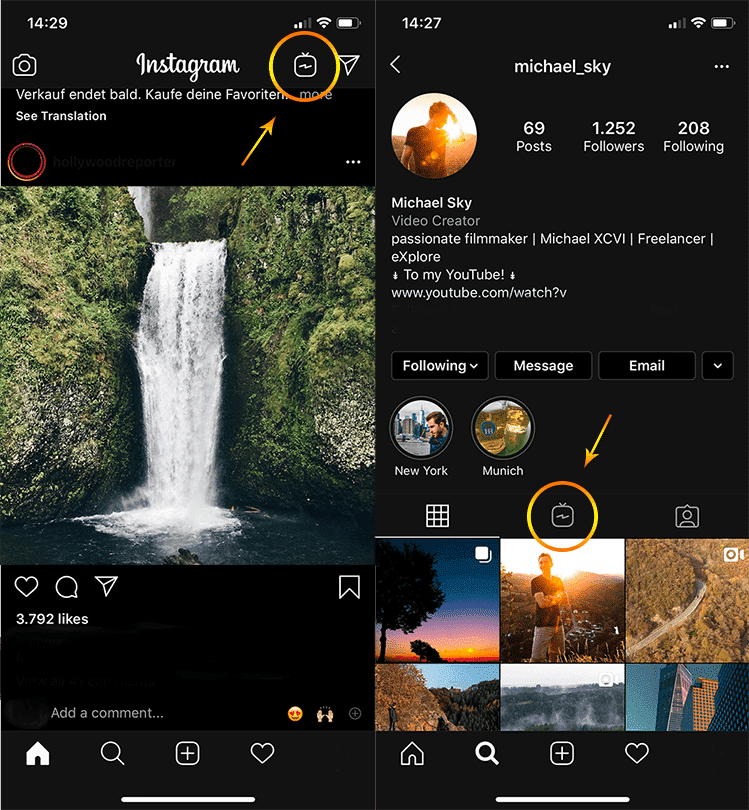
When this article was written, IGTV (short for Instagram TV) was a relatively new addition (it has since been discontinued). It let you post videos longer than 60 seconds. The videos did not appear in the normal feed but in a separate IGTV feed, apart from photos and short videos (circled in the following image).
For some time now, Instagram has also had Reels: short, entertaining videos with a fun factor that you can simply scroll through, very similar to TikTok. You can already tell: Instagram likes to take its cue from other social media apps and adopt one feature or another. Many people post very TikTok-like videos in their Reels, or simply their TikToks directly. So Instagram practically bundles the best features of its “competitors” and is an all-purpose app that is also becoming more and more useful as a business tool for companies.
Which topics are successful on Instagram?
As anyone who has used Instagram knows, you can tailor it quite precisely to your interests and find something on Instagram for every topic. The most-used hashtags directly reflect the biggest areas of interest – both those with the largest target group and those with the largest supply.
From still lifes to model photos, there are no taboos and nothing is “too big” on Instagram. On the contrary: the more professional, the better – so you stand out from the mass of posts.
800 million monthly active users worldwide (more than twice as many as Twitter)
90 of the top 100 brands have an Instagram account
The users’ interaction rate (i.e. clicks, likes and comments) is 10x higher than on Facebook and 84x higher than on Twitter
90% of users are younger than 35
80% of Instagrammers follow at least one business
What can Instagram do for businesses?
That sounds great at first. But what specifically can Instagram do for businesses – and for yours in particular? The good news: you don’t have to be a global brand or have a huge marketing budget to be successful on Instagram.
However, you should get to know the network and the competition, because the advantages also bring a disadvantage: users are spoilt by high-quality content.
Instagram is worthwhile for almost every company. Its uses fall into two main areas: particularly aesthetic products/services and personal insights into everyday life. Every company can serve one of the two categories. Fun fact: so-called “influencers” (brand ambassadors; people with several (hundred) thousand fans on Instagram) usually have both: they give very personal insights into their lives and present themselves perfectly at the same time.
You don’t have to be a global brand to be successful on Instagram
Two ways of using Instagram: aesthetic products or personal insights into everyday life
Instagram is perfect for your company if you have visual products, services or premises. As the motto goes: if it can be staged visually and presented beautifully, Instagram is right for your business.
If your company works in one of the categories mentioned above, such as fitness, leisure, food and drink, beauty, people, decoration, furniture and the environment, you practically have home advantage.
If you are a restaurant: photograph your dishes. If you are a hairdresser: take before-and-after photos. If you make a product or have a nice shop: take pictures of it.
But even if you are a supplier to the automotive or medical technology industry: show the “finished product” in which your part is installed. As a service provider: stage your meetings, present your portfolio, take close-ups of your workplaces or of the team.
Product: lipstick / blusher
Product: headphones
Anything that can be shown in an image brochure or on the website fits on Instagram. If you don’t fall into any of these categories, that’s no reason not to use Instagram for your business. Simply give…
Personal insights into everyday life
Instagram is the most personal of all social networks, which at the time of writing was also reflected in an interaction rate up to 50x higher than on Facebook and Twitter. So it is the perfect place for a company to build personal relationships.
This works, among other things, through posts from production, from the team in the office, or about projects and products you have recently made. But also funny moments that happened in the team. What you post and what it might look like depends largely on your company image and the message the company conveys or wants to convey to the outside world.
Examples:
Pay attention to your company image and your company’s core messages
Personal insights come across as likeable to users
Insights into everyday life build closeness to users
How to use Instagram for your business the right way
Instagram can give your marketing an enormous boost, because users automatically tend to have a more positive attitude towards, and more sympathy for, companies with Instagram pages.
Define your strategy
Decide what your Instagram strategy is and what goal you are pursuing. One example would be increasing your brand awareness. Or perhaps you want to get to know your target groups better.
Your strategy also includes deciding when to publish which content and which hashtags to use so that you are discovered faster on the platform.
Create an account
Create a business profile. Although experts keep whispering that business profiles on Facebook and Instagram get less organic reach than private profiles, a business profile brings you other, more important advantages:
It lets you view the statistics for your posts and stories free of charge and see straight away whether a new style is a success or a failure. At the time of writing, your Facebook page was also linked to your Instagram profile immediately (if you had one), or a new one was created (if you didn’t). This gives you a new line in your profile describing your industry. Your profile also shows a direct way to contact you by email, phone and/or location.
Whatever you do, don’t forget the link to your website. This also creates traffic to your site. Users may prefer to click a direct link rather than search for the site online themselves.
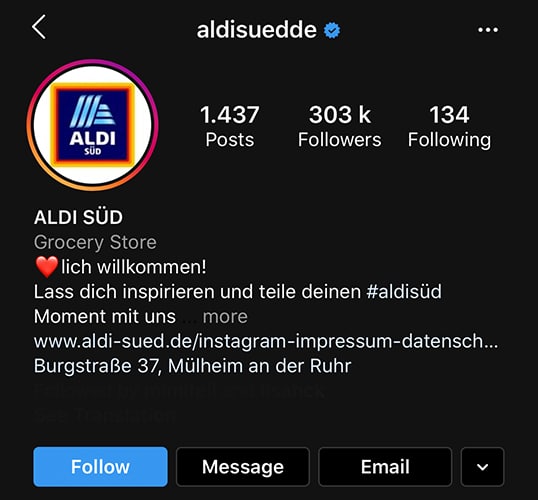
Use a profile picture that makes you easy to recognise and suits Instagram. It can be your logo, mascot or a symbol – the main thing is that it is memorable and fits Instagram. A very long logo lettering that is hard to read is not ideal, for example, but an interchangeable symbol isn’t the best choice either. You know your brand best – and if you want help from professionals: no problem! There are many agencies that specialise in Instagram marketing and can help you set up an account and create content.
Example of a good Instagram bio
Example 2 of a good Instagram bio
Create a business profile
Choose a profile picture that is easy to recognise
Include the link to your website in your bio
Create content
Instagram is a very visual platform. While you can get good results on Facebook and Twitter with text-only posts, on Instagram there have to be images – ideally extraordinary, high-quality ones.
The most successful Instagram accounts use their images to tell their story. Use the “caption” for this. It can be anything from a few words to several paragraphs long and contain anything you like – except links! At the time of writing, links on Instagram were only possible in the profile and in paid posts and stories.
If you want an image to point to a product or a web page, write in the caption that the link is in your “bio” (the short description of your profile). Bloggers, for example, change this link every time a new blog article goes online.
Try to give your images a recognisable look. The same font, hashtags or filters are ways of doing this. It goes without saying, but: stick to your subject area. If you sell trainers, your images shouldn’t be about cars – unless your product is in the picture too.
An editorial plan is recommended for creating content. Read here how a good editorial plan can maximise your social media success.
Like every other social network, Instagram thrives on interaction. Instagram offers businesses various ways to do this:
Ask your followers a question in the caption or in the image itself. This improves your interaction rate and reach.
Use the Stories feature. At the time of writing, the interaction rate here was up to 60% higher.
Run competitions. You can ask your followers to comment under the image and/or tag one (or more) other accounts. You can also require users to share the image on their own channel to take part.
If a user has taken a picture of your brand or product or mentioned you, interact. Like and reply – and repost the image if appropriate.
You can ask your followers and other users to post photos with your products. You can also team up with influencers for this. A brand ambassador who already uses the products is a perfect point of contact. Make yourself known in the influencer’s community too.
Like other companies now and then. If other companies’ products appear in your photo, don’t hesitate to tag them. This can help you be discovered more easily.
Our tip: In Germany, following court rulings on advertising on Instagram at the time of writing, we strongly recommended labelling as (unpaid) advertising all posts showing other people, brands or accounts. A hashtag alone was not enough; instead, a note such as “(Unpaid) advertising (through tagging/placement)” had to be placed before or after the post. This also applied to Stories!
Instagram as an advertising platform
Just as on Facebook, you can also run targeted ads on your Instagram posts. Budgets start with very small amounts – at the time of writing from 2 euros – and go up into six figures or more. With these ad posts, you can target very precisely who you want to reach. Targeting means defining your target group precisely: from geographical limits right down to personal interests, for example: woman, aged 20–25, living in Cologne, interested in fashion and dogs, engaged.
Ads can be run as videos or as photos. You can also insert a direct link to a landing page or to the product page on your website. The ad simply appears on the user’s home feed, between the channels they already follow. The advantage is that users automatically accept the ad more readily and are more willing to click.
What advertising on Instagram brings you:
More reach
Targeted communication
Direct link integration
Conclusion: Instagram for businesses
When this article was last updated, Instagram was still one of the strongest social media platforms, and companies in particular had become an established presence there – giving not only insights into the company but also creating sympathy and closeness with potential customers. If you are not active yet, you should consider Instagram for your company too. It’s worth it!
If you would like to go deeper into the topic of online marketing, I recommend the following articles:
Yvonne Schwalowski ist Marketingberaterin und strategische Filmproduzentin bei Pathfinder Studios sowie mehrfache Belletristik-Autorin u.a. beim Piper-Verlag. Mit 18 Jahren Berufserfahrung und erfolgreichen Multimedia-Projekten für 450+ Kunden ist sie eine erfahrene Marketing-Expertin für europäische Unternehmen – vom Tech-Startup über Hidden Champion-Industrieunternehmen bis zu Konzernen wie MAN, Miele und Audi. Ihre Werbefilme und Kurzfilme haben mehrere internationale Auszeichnungen gewonnen, ihr erster internationaler Kinospielfilm ist derzeit in Fertigstellung. Wikipedia – Portfolio – LinkedIn – IMDb
Yvonne Schwalowski ist Marketingberaterin und strategische Filmproduzentin bei Pathfinder Studios sowie mehrfache Belletristik-Autorin u.a. beim Piper-Verlag. Mit 18 Jahren Berufserfahrung und erfolgreichen Multimedia-Projekten für 450+ Kunden ist sie eine erfahrene Marketing-Expertin für europäische Unternehmen – vom Tech-Startup über Hidden Champion-Industrieunternehmen bis zu Konzernen wie MAN, Miele und Audi. Ihre Werbefilme und Kurzfilme haben mehrere internationale Auszeichnungen gewonnen, ihr erster internationaler Kinospielfilm ist derzeit in Fertigstellung.
Wikipedia – Portfolio – LinkedIn – IMDb